László Moholy-Nagy (1895–1946). Hungarian-born painter, sculptor, designer, photographer, experimental artist, and writer who became an American citizen in 1944. He was born in Bácsborsod and studied law at Budapest University before serving in the Austro-Hungarian army in the First World War. He took up art in 1917 whilst recovering from a wound and was completely self-taught in his wide range of skills. By temperament he was an engineer and his approach to art was methodical and rational; he even gave his works pseudo-scientific titles consisting of combinations of letters and numbers, such as K VII (Tate Gallery,London, 1922), the ‘K’ standing for ‘Konstruction'. In 1919 he moved to Vienna and then in 1921 to Berlin, where he painted abstract pictures influenced by Lissitzky (himself recently arrived from Russia). He also experimented with collage, photograms (see SCHAD), and photomontage, and in 1922 had his first one-man exhibition at the Sturm Gallery. From 1923 to 1928 he taught at the Bauhaus, taking over from Itten the running of the preliminary course. Frank Whitford (Bauhaus, 1984) emphasizes the difference in approach between these two highly distinctive characters: ‘Even Moholy's appearance proclaimed his artistic sympathies. Itten had worn something like a monk's habit and had kept his head immaculately shaved with the intention of creating an aura of spirituality and communion with the transcendental. Moholy sported the kind of overall worn by workers in modern industry. His nickel-rimmed spectacles contributed further to an image of sobriety and calculation belonging to a man mistrustful of the emotions, more at ease among machines than human beings.’
As well as directing the preliminary course, Moholy was also co-editor, with Gropius, of the Bauhaus publications. The substance of his teaching was summed up in his book Von Material zu Architektur (1929), translated as The New Vision, from Material to Architecture (New York, 1932). Although he was regarded as a brilliant teacher, his assertiveness and rejection of a spiritual dimension in art made him unpopular with some of his colleagues. He resigned when Hannes Meyer replaced Gropius as director in 1928, then worked for some years in Berlin, chiefly on stage design and experimental film. In 1934 he left Germany because of the Nazis, moving to Amsterdam and then in 1935 to London, where he worked on designs for the science fiction film Things to Come (1936), produced by his fellow-Hungarian Alexander Korda, and contributed to the Constructivist review Circle (1937). In 1937 he emigrated to Chicago, where he became director of the short-lived New Bauhaus (1937–8), then founded his own School of Design (1939; it changed its name to the Institute of Design in 1944), directing it until his death.
Moholy was one of the most inventive and versatile of Constructivist artists, pioneering especially in his use of light, movement (see KINETIC ART), photography, and plastic materials, and he was one of the most influential teachers of the 20th century. He was an emphatic advocate of the Constructivist doctrine that so-called fine art must be integrated with society as a whole. His views were most fully expressed in his posthumously published book Vision in Motion (1947), but even at the outset of his career his utilitarian outlook had been clear: ‘My conscience asks unceasingly: is it right to become a painter at a time of social upheaval?', he wrote in his diary in 1919. ‘During the last hundred years art and life have had nothing in common. The personal indulgence of creating art has contributed nothing to the happiness of the masses.’

photograms:
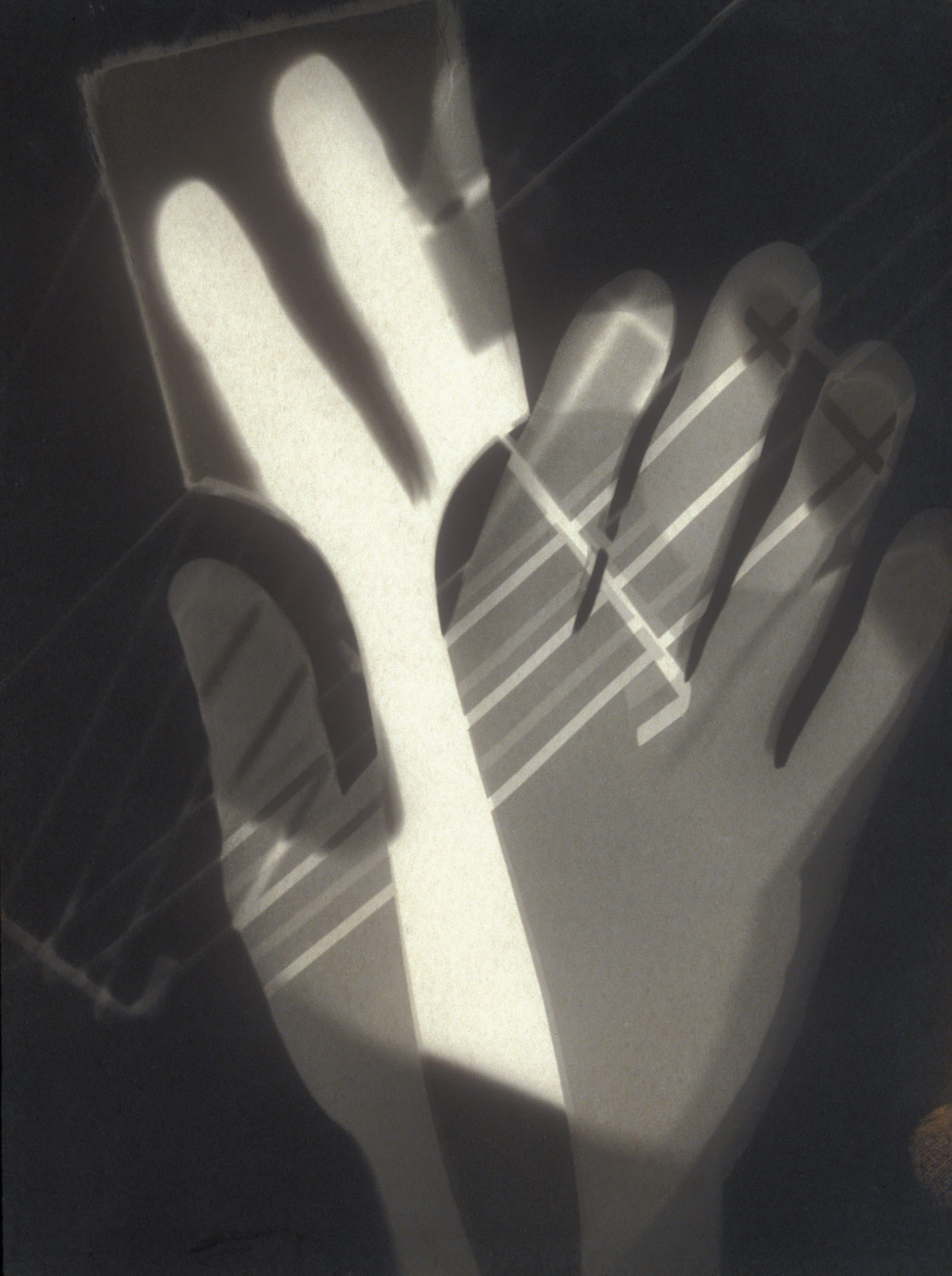


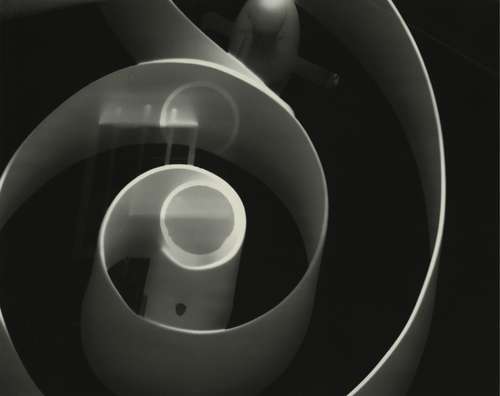
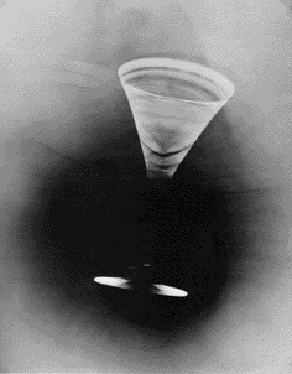

Architects' Modern Congress, 1933: Moholy-Nagy's cinematic journal, which recorded the meeting of the CIAM (International Congress of Modern Architecture) in August of 1933. The meeting was held on a yacht that cruised the Mediterranean Sea between Marseille, the Aegean Islands, and Athens. Congress participants included such notables as Le Corbusier, van Eesteren, Giedion, and Leger.
As well as directing the preliminary course, Moholy was also co-editor, with Gropius, of the Bauhaus publications. The substance of his teaching was summed up in his book Von Material zu Architektur (1929), translated as The New Vision, from Material to Architecture (New York, 1932). Although he was regarded as a brilliant teacher, his assertiveness and rejection of a spiritual dimension in art made him unpopular with some of his colleagues. He resigned when Hannes Meyer replaced Gropius as director in 1928, then worked for some years in Berlin, chiefly on stage design and experimental film. In 1934 he left Germany because of the Nazis, moving to Amsterdam and then in 1935 to London, where he worked on designs for the science fiction film Things to Come (1936), produced by his fellow-Hungarian Alexander Korda, and contributed to the Constructivist review Circle (1937). In 1937 he emigrated to Chicago, where he became director of the short-lived New Bauhaus (1937–8), then founded his own School of Design (1939; it changed its name to the Institute of Design in 1944), directing it until his death.
Moholy was one of the most inventive and versatile of Constructivist artists, pioneering especially in his use of light, movement (see KINETIC ART), photography, and plastic materials, and he was one of the most influential teachers of the 20th century. He was an emphatic advocate of the Constructivist doctrine that so-called fine art must be integrated with society as a whole. His views were most fully expressed in his posthumously published book Vision in Motion (1947), but even at the outset of his career his utilitarian outlook had been clear: ‘My conscience asks unceasingly: is it right to become a painter at a time of social upheaval?', he wrote in his diary in 1919. ‘During the last hundred years art and life have had nothing in common. The personal indulgence of creating art has contributed nothing to the happiness of the masses.’
photograms:
Architects' Modern Congress, 1933: Moholy-Nagy's cinematic journal, which recorded the meeting of the CIAM (International Congress of Modern Architecture) in August of 1933. The meeting was held on a yacht that cruised the Mediterranean Sea between Marseille, the Aegean Islands, and Athens. Congress participants included such notables as Le Corbusier, van Eesteren, Giedion, and Leger.

No comments:
Post a Comment