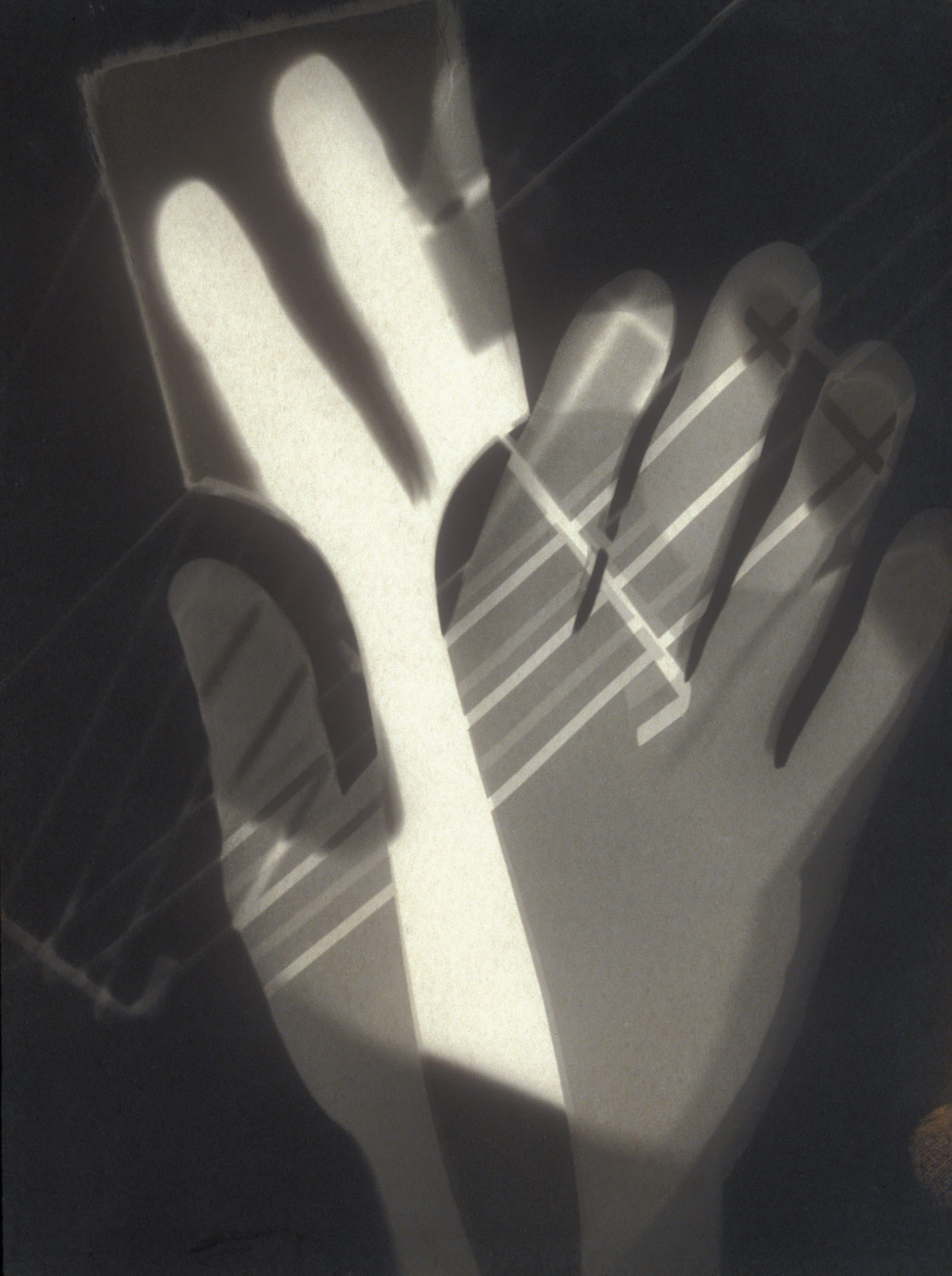
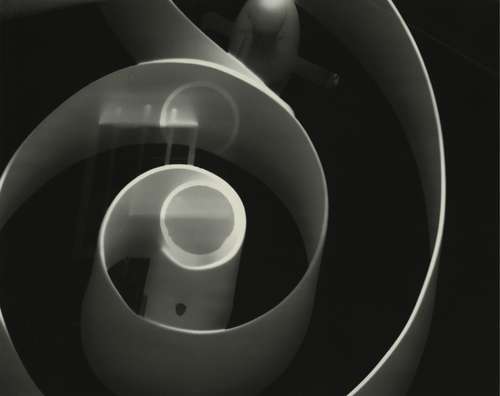
László Moholy-Nagy (1895–1946). Hungarian-born painter, sculptor, designer, photographer, experimental artist, and writer who became an American citizen in 1944. He was born in Bácsborsod and studied law at Budapest University before serving in the Austro-Hungarian army in the First World War. He took up art in 1917 whilst recovering from a wound and was completely self-taught in his wide range of skills. By temperament he was an engineer and his approach to art was methodical and rational; he even gave his works pseudo-scientific titles consisting of combinations of letters and numbers, such as K VII (Tate Gallery,London, 1922), the ‘K’ standing for ‘Konstruction'. In 1919 he moved to Vienna and then in 1921 to Berlin, where he painted abstract pictures influenced by Lissitzky (himself recently arrived from Russia). He also experimented with collage, photograms (see SCHAD), and photomontage, and in 1922 had his first one-man exhibition at the Sturm Gallery. From 1923 to 1928 he taught at the Bauhaus, taking over from Itten the running of the preliminary course. Frank Whitford (Bauhaus, 1984) emphasizes the difference in approach between these two highly distinctive characters: ‘Even Moholy's appearance proclaimed his artistic sympathies. Itten had worn something like a monk's habit and had kept his head immaculately shaved with the intention of creating an aura of spirituality and communion with the transcendental. Moholy sported the kind of overall worn by workers in modern industry. His nickel-rimmed spectacles contributed further to an image of sobriety and calculation belonging to a man mistrustful of the emotions, more at ease among machines than human beings.’
As well as directing the preliminary course, Moholy was also co-editor, with Gropius, of the Bauhaus publications. The substance of his teaching was summed up in his book Von Material zu Architektur (1929), translated as The New Vision, from Material to Architecture (New York, 1932). Although he was regarded as a brilliant teacher, his assertiveness and rejection of a spiritual dimension in art made him unpopular with some of his colleagues. He resigned when Hannes Meyer replaced Gropius as director in 1928, then worked for some years in Berlin, chiefly on stage design and experimental film. In 1934 he left Germany because of the Nazis, moving to Amsterdam and then in 1935 to London, where he worked on designs for the science fiction film Things to Come (1936), produced by his fellow-Hungarian Alexander Korda, and contributed to the Constructivist review Circle (1937). In 1937 he emigrated to Chicago, where he became director of the short-lived New Bauhaus (1937–8), then founded his own School of Design (1939; it changed its name to the Institute of Design in 1944), directing it until his death.
Moholy was one of the most inventive and versatile of Constructivist artists, pioneering especially in his use of light, movement (see KINETIC ART), photography, and plastic materials, and he was one of the most influential teachers of the 20th century. He was an emphatic advocate of the Constructivist doctrine that so-called fine art must be integrated with society as a whole. His views were most fully expressed in his posthumously published book Vision in Motion (1947), but even at the outset of his career his utilitarian outlook had been clear: ‘My conscience asks unceasingly: is it right to become a painter at a time of social upheaval?', he wrote in his diary in 1919. ‘During the last hundred years art and life have had nothing in common. The personal indulgence of creating art has contributed nothing to the happiness of the masses.’
photograms:
Architects' Modern Congress, 1933: Moholy-Nagy's cinematic journal, which recorded the meeting of the CIAM (International Congress of Modern Architecture) in August of 1933. The meeting was held on a yacht that cruised the Mediterranean Sea between Marseille, the Aegean Islands, and Athens. Congress participants included such notables as Le Corbusier, van Eesteren, Giedion, and Leger.
Nam June Paik (July 20, 1932 – January 29, 2006) was a Korean-born American artist. He worked with a variety of media and is considered to be the first video artist.
Nam June Paik then began participating in the Neo-Dada art movement, known as Fluxus, which was inspired by the composerJohn Cage and his use of everyday sounds and noises in his music. He made his big debut at an exhibition known as Exposition of Music-Electronic Television, in which he scattered televisions everywhere and used magnets to alter or distort their images.
In 1964, Paik moved to New York, and began working with classical cellist Charlotte Moorman, to combine his video, music, and performance. In the work TV Cello, the pair stacked televisions on top one another, so that they formed the shape of an actualcello. When Moorman drew her bow across the "cello," images of her and other cellists playing appeared on the screens.
In 1965, Sony introduced the Portapak (though it is said that Paik had a similar one before Sony released theirs). With this, Paik could both move and record things, for it was the first portable video and audio recorder. From there, Paik became an international celebrity, known for his creative and entertaining works.
In a notorious 1967 incident, Moorman was arrested for going topless while performing in Paik’s Opera Sextronique. Two years later, in 1969, they performed TV Bra for Living Sculpture, in which Moorman wore a bra with small TV screens over her breasts.Throughout this period it was his goal to bring music up to speed with art and literature, and make sex an acceptable theme. One of his Fluxus pieces instructs the performer to climb up inside the vagina of a living sperm whale.
In 1971, he made a cello out of three television sets stacked up on top of each other and some cello strings. He got a famous cellist to play the "cello" as well.
In 1974 Nam June Paik used the term "super highway" in application to telecommunications, which gave rise to the opinion that he may have been the author of the phrase "Information Superhighway". In fact, in his 1974 proposal "Media Planning for the Postindustrial Society – The 21st Century is now only 26 years away" to Rockefeller Foundation he used a slightly different phrase, "electronic super highway":
Weegee was the pseudonym of Arthur Fellig (June 12, 1899 – December 26, 1968), a photographer and photojournalist, known for his stark black and white street photography.
Weegee worked in the Lower East Side of New York City as a press photographer during the 1930s and '40s, and he developed his signature style by following the city's emergency services and documenting their activity.[1] Much of his work depicted unflinchingly realistic scenes of urban life, crime, injury and death. Weegee published photographic books and also worked in cinema, initially making his own short films and later collaborating with film directors such as Jack Donohue and Stanley Kubrick.
Nikola Vuco (1902-1993) was Serbian surrealist photograph, which was one of the first surrealism artist in serbia, one of the founder of the first avant garde surrealism magazine in Belgrade called Vecnost (Eternity ) in 1926.
His legacy to the Museum of Applied Art consists of the original negatives and photographs taken both in Paris and Belgrade in 1929 and 1930.
Vuco transformed the conventional relationship between photography and reality, he allowed it to double and multiply the objects, to cut and decompose previously photographed wholes, to enlarge certain fragments to the very limits of recognition, or the making of images within images. In this way Vuco created works that could be compared to the most important creations in Surrealist photography in the world.
They're cut-out dioramas. He takes pulp novels and gets busy with a scalpel to create dynamic new interpretations of the covers. And they're lush. They also put us in mind of Lars bon Trier's Dogville, which is no bad thing.