"I don't remember
lighting this cigarette
and I don't remember
if I'm here alone
or waiting for someone."
— Leonard Cohen

Tuesday, 14 December 2010

Thursday, 9 December 2010

rgb


RGB
Color est e pluribus unus

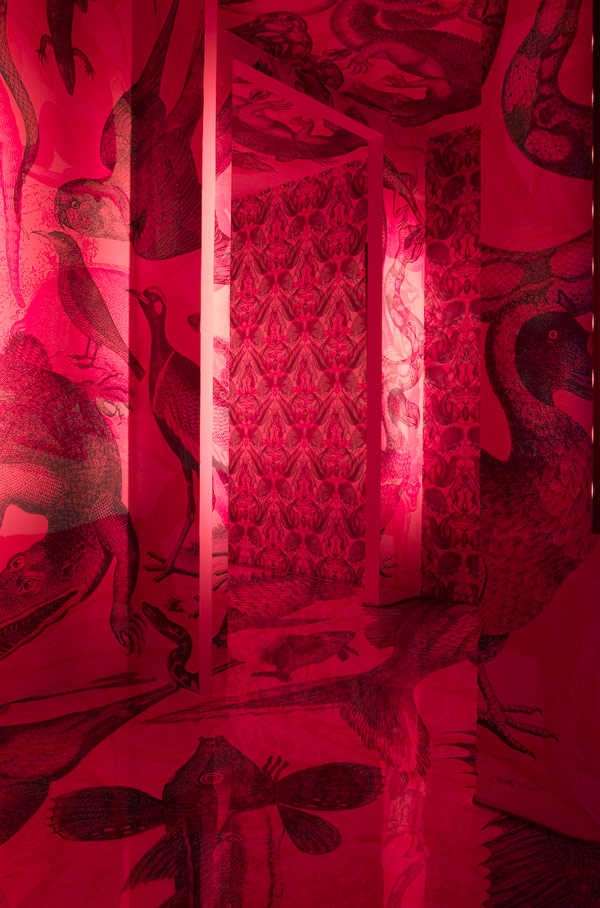
RGB is a work about the exploration of the “surface’s deepness”.
RGB designs create surfaces that mutate and interact with different chromatic stimulus.

RGB’s technique consists in the overlapping of three different images, each one in a primary color. The resulting images from this three level’s superimposition are unexpected and disorienting. The colors mix up, the lines and shapes entwine becoming oneiric and not completely clear. Through a colored filter (a light or a transparent material) it is possible to see clearly the layers in which the image is composed. The filter’s colors are red, green and blue, each one of them serves to reveal one of the three layers.

Carnovsky 

Thursday, 2 December 2010

imagination comes to life

whit  Yeondoo Jung’s Wonderland series. He takes children’s illustrations and re-creates them in staged photographs. Some are incredibly spot-on accurate, while others had some creative tweaking added to complete the image.


kolo


“Kolo”, created by French-artist Natacha Paganelli during her artist residency in Serbia. It is currently on display at Kunsthalle Mulhouse(France) until January.

eyes

haunted mirrors by artist allison diaz


haunted mirrors by artist allison diaz


haunted mirrors by artist allison diaz


haunted mirrors by artist allison diaz

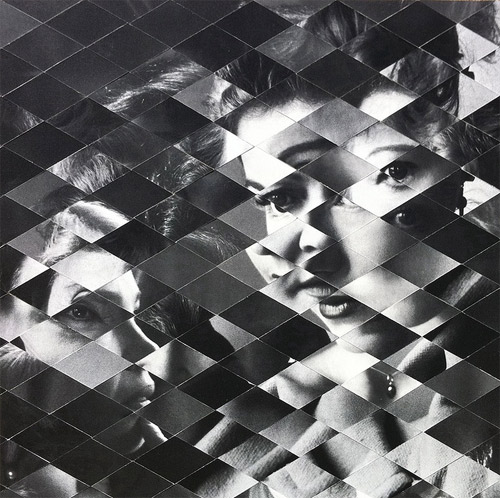
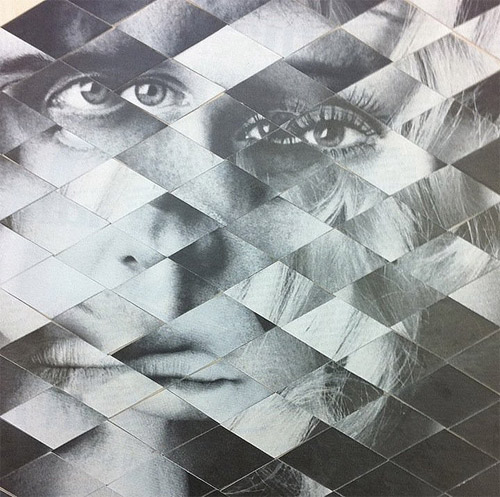
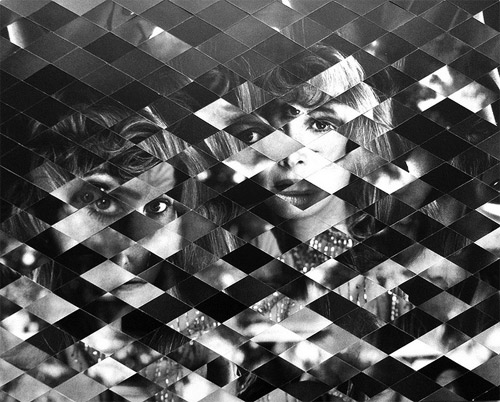
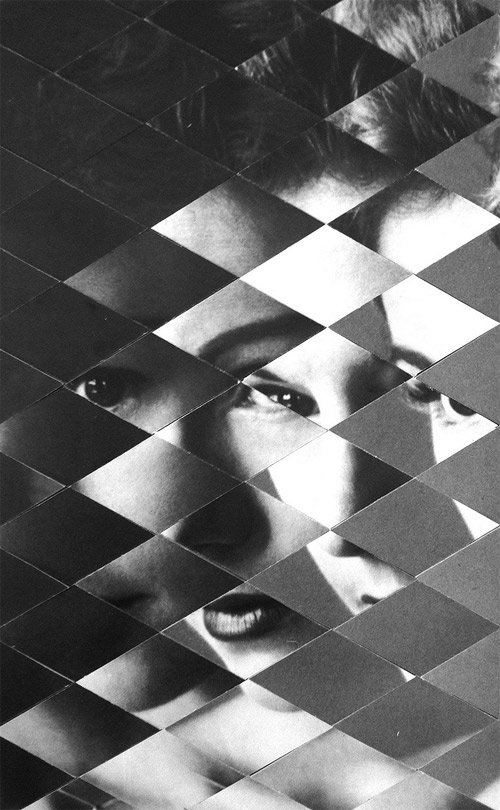
“Haunted Mirrors”, collages by Allison Diaz.

Wednesday, 24 November 2010

face project


Tina and Michelangelo blur the boundaries between fashion photography, drawing, and painting. 

Ignoring the computer’s possibilities for manipulation, they combined their fields of work, photography, and drawing, anachronistically in an analogue way.

Monday, 15 November 2010

music

one of the best female artist!


Juana Molina's fifth full-length album, Un Dia, is being described as a bold  departure from previous records. That's not to say Molina hasn't made these songs personal and visceral. Not only has she done that, but she's splashed more rhythms and tribal sounds all over the body of these tracks. An invigorating, trance inducing record full of energy that forces any person with a soul to feel alive with the spirit. The multifarious tracks weave in and out through cymbals and wood and bombo leguero, and sewed together with electronic intervals and a worldly mixture of Molina's lyrics. It makes for an inspiring and interactive listen. Some high profile supporters of her music have been David Byrne, NPR, and The NY Times.

try

Tuesday, 9 November 2010

old time


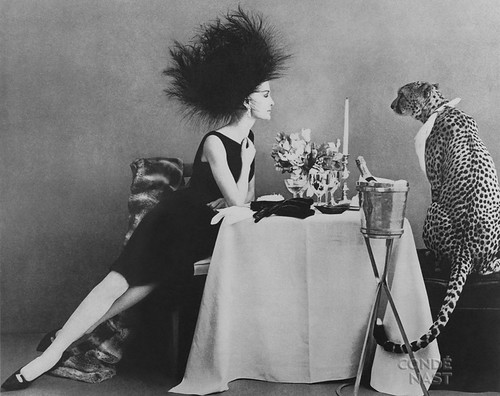
 The perfect Lilly Daché, She was the French milliner and a fashion designer in the XX century

Monday, 8 November 2010

music

nice indi album for a change :)


Yellow Ostrich the mistress download mp3 free
Genre: american,lo-fi,acoustic
Bitrate: MP3 / V0 (VBR) / WEB
Duration: 30:30
Size: 57 mb
1. I Think U Are Great (01:21)
2. WHALE (03:43)
3. Hate Me Soon (01:57)
4. Hold On (02:59)
5. Libraries (04:38)
6. Hahahaohhoho (02:51)
7. I'll Run (03:03)
8. Campaign (03:02)
9. Mary (04:28)
10. Slow Paddle (02:28)


Wednesday, 3 November 2010

fashion

Marimekko Spring/Summer 2011 Fashion Show

wonderful


Wednesday, 20 October 2010

Thursday, 14 October 2010

theatre

isabela's room by jan lauwers and needcompany 


Isabella’s room contains a secret. It is the location of a lie. It is the location of the lie that dominates Isabella’s existence. This lie is an image. An exotic image. The image of a desert prince. Isabella is the daughter of a desert prince who disappeared on an expedition. This is what her foster parents, Arthur and Anna, told her. They lived together in a lighthouse on an island, where Arthur was the lighthouse-keeper. Like an island, the lighthouse is a transitional area: somewhere between the sea and the land, between solid and fluid, between inside and outside. The lighthouse is built on the land, but it yearns for the sea. Isabella yearns for the desert, the desert prince, Africa. 

This is how the life-story of the blind old Isabella begins. But it soon becomes clear that a terrible, unutterable truth lies hidden beneath the story of the desert prince. Anna and Arthur cannot live with their secrets and escape into drink. Anna dies and Arthur throws himself into the sea. Isabella’s quest for her father, the desert prince, does not lead her to Africa but to a room in Paris, filled with anthropological and ethnological objects. 

Isabella tells the story of her life, but she does not tell it alone. All those who were important to her tell it with her; the many in her life who had died: Arthur and Anna, her lovers Alexander and Frank. And not only do they tell Isabella’s story together, they also sing it. This is not the first time in a piece by Jan Lauwers that live music is played and that the actors sing, but it has never happened in such an open and inviting way as here. 
(Erwin Jans)
i have to add that the music in this performance is one of the best, it's very moving whit great and meaningful  lyrics by jan.


Saturday, 2 October 2010

artificalie

Lars Tunbjörk


Lars Tunbjörk’s video installation entitled Wunder-baum is comprised of a series of photographs of flowers and constructed nature scenes, taken over a period of years at garden fairs in Stockholm. Tunbjörk (b. 1956) is interested in exploring how flowers are utilized within the commercial environment, and how nature is reconstructed and presented. Additionally these reconstructions reflect the Swedes’ love for nature in an absurd way. The flower images are integrated with a series of car interiors photographed through parked car windows in Stockholm.


fotografiska


Sandy Skoglund


The photograph, for much of its history, represented the pillar of truth and objectivity. It was a material document of a moment in time. However, the advent of the digital ­revolution has changed our perception of the photographic image. Since the arrival of digital editing, we, more often than not, question its authenticity. We no longer instinctively believe in the photograph as an index or imprint of reality. Which makes it of utmost ­interest to revisit the work of photographers like American artist Sandy Skoglund.
Skoglund, who is of Swedish descent, is a pioneer of the reinvention of tableau vivant photography also referred to as staged photography. She belongs to an energetic set of artists that have been active in the United States since the 1970s, such as Cindy Sherman and Joel-Peter Witkin. Like a scenographer who crafts sets for the theater, Skoglund creates elaborate and colorful environments. Her installations are the culmination of months of planning and construction. Each installation is a work of art in its own right, which is then photographed with a large-format camera.
Skoglund represents a time when artists began to transverse mediums. Previously, photography was largely dominated by documentary work. Constructions created for the photograph, by artists like Skoglund, were seldom encountered. In fact, when we believed in the authenticity of the photograph, Skoglund’s pictures astonished us because we viewed them as documents. Before digital editing, one understood that Skoglund’s figures were sculpted, rooms were built up and painted, and each detail was touched by the hand of artist.
Skoglund’s dreamlike imagery continues to intrigue us. Her work is grounded in the experience of suburban middle class living. Skoglund was a vivacious and creative child, who felt strangely marginalized within the conformity of life in small town America. Consequently, her complex investigations of domestic environments often depict the world constructed by man in opposition to nature. For example, the animals in Skoglund’s work appear like spirits among the human inhabitants, who seem oblivious to their existence. As nature encroaches, it appears that we deny the very thing of which we are a part.
Skoglund highlights the idiosyncrasy of our manufactured world, as depicted in her still life of cubed carrots laid out in neat little rows on a polka dot plate. Her pop-art palette references the artificial materiality of our own constructed world, and the tivoli that is our consumption. Her imagery is enthralling, and yet we instinctively sense falseness in the frivolity. Human ingenuity is depicted as both imaginative and dysfunctional, an anomaly within the natural balance of ecosystems. Skoglund comments on what we have sought to suppress via the joys of consumption, our subservience to and our fear of the natural world.
- Chief Curator Michelle Marie Roy

Thursday, 30 September 2010

music in my head

new album from peter broderck
i think it's wonderful but i left you decide


Peter Broderick - How They Are

Label: Bella Union
Catalog#: BELLACD254
Format: CD, Album
Country: Europe
Released: 06 Sep 2010
Genre: Classical, Folk, World, & Country
Style: Neo-Classical, Folk

Tracklist
1 Sideline 4:51
2 Human Eyeballs On Toast 4:47
3 Guilt's Tune 4:27
4 When I'm Gone 3:46
5 With A Key 4:29
6 Pulling The Rain 5:28
7 Hello To Nils 4:30

buy: boomkat
A new collection of songs from musical polymath Peter Broderick, How They Are finds the prodigious singer, songwriter, arranger and multi-instrumentalist working his way through some of his most intimate recordings to date. The real standout proves to be 'Sideline', an opening track that begins with Broderick's voice alone and exposed in acappella mode before some lonesome piano chords join in. It's a beautiful piece that finds the songwriter's voice and tone evoking a mixture of Arthur Russell and Jackson Browne. Further down the tracklist, 'With A Key' reinforces this effect, offering further evidence that this is an artist whose writing has sharpened up considerably since his earliest forays. Switching to guitar, Broderick runs through an atmospheric Jim O'Rourke-like lope through 'Guilt's Tune', while fans of the minimal instrumental collection, Docile (on Kning Disk), will surely appreciate the wordless piano narratives of 'When I'm Out' and 'Pulling The Rain' - both representing clear advancements in this side of Broderick's output. These pieces at times bring to mind the work of Broderick's pal and musical cohort, Nils Frahm, something perhaps underlined by closing track 'Hello To Nils', a lovely piece about life on the road. It transpires to be a bit of a strange closer, featuring a spoken "old news/new news" passage that brings to mind one of Demetri Martin's deadpan comedy songs (albeit without the comedy, as such). While some fans may find themselves pining for the more neo-classical oriented end of Broderick's material, How They Are does well to focus on a single aspect of his work, presenting a concise and gratifying set of songs that serves as a generous between-albums release.

try

Tuesday, 28 September 2010